Tumia Romero, Ph.D.

Book coming soon

Reserve a copy

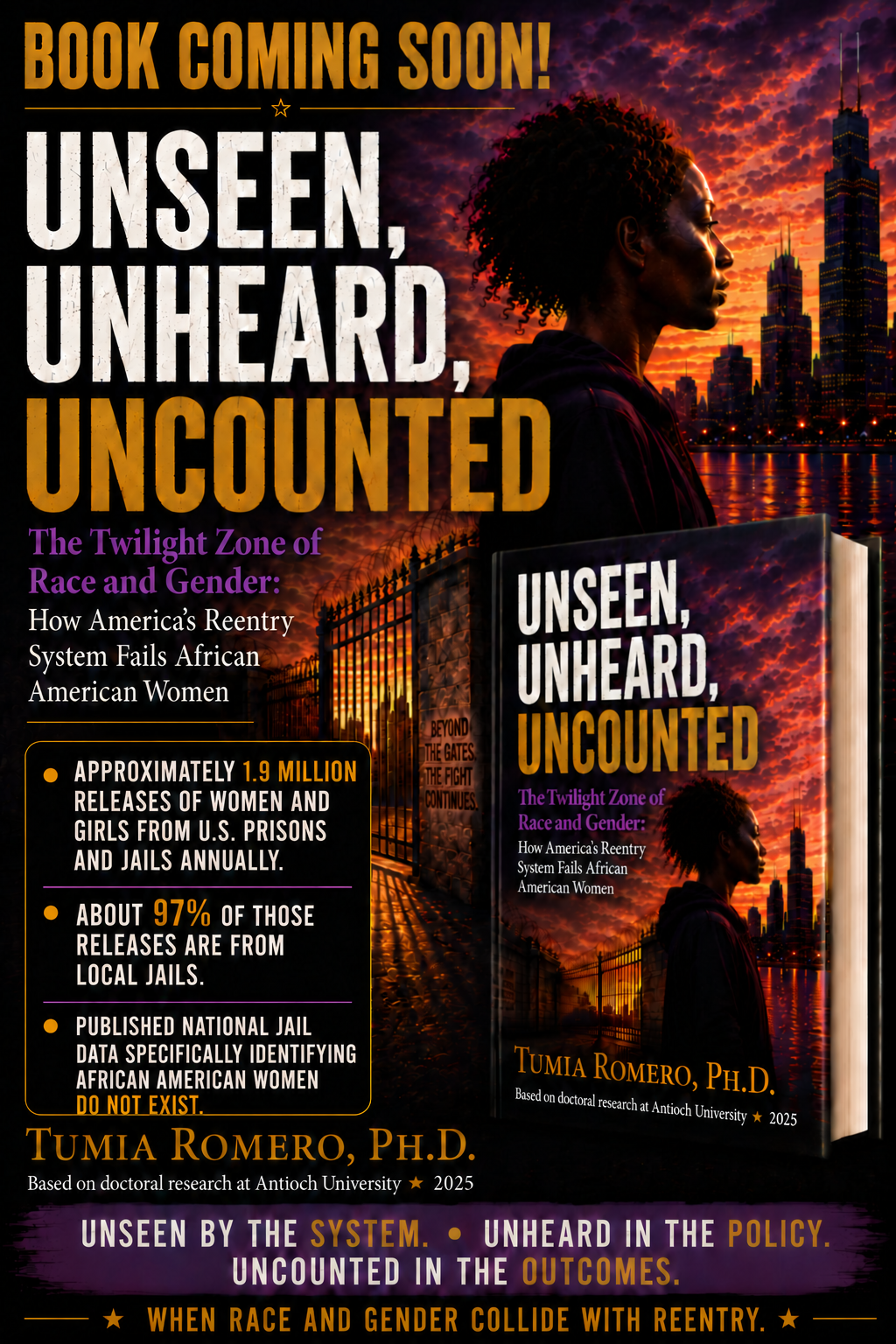
Unseen,Unheard,Uncounted

The Twilight Zone of Race and Gender:

How America’s Reentry System Fails African American Women

Tumia Romero, Ph.D.Based on doctoral research at Antioch University

With a foreword by Congressman Danny K. Davis

Paperback ISBN: 979-8-234-26046-8

Reserve a copy
Book announcement artwork showing the title Unseen, Unheard, Uncounted against a twilight city skyline and prison gates
Book announcement artwork

A guide to the book

Inside the Book

A short guide to what each part of this book does for readers who want to find a particular argument or know where they are going before they start.

View the Table of Contents
Preface

Why I wrote this book, what the Social Determinants of Reentry framework is, and what it means to have been a statistic before becoming the person who counted them.

“My father was in prison when I was born. He spent most of my life behind bars, a person with a heroin addiction who cycled through the criminal justice system long before I had words to understand what that meant. Before he ever became my father in any meaningful daily sense, he was a ward of the state—a foster child himself, shaped by a system that failed him early and continued to fail him for decades. I grew up knowing the particular silence that fills a home when a parent is absent, not by choice but by incarceration. I grew up understanding, without anyone having to explain it, that the criminal justice system does not affect everyone the same way, and that the people it touches most deeply are often the people with the fewest resources to survive the encounter.”
“What I did not fully understand for most of my adult life is that I was not just a witness to these systems. I was a part of the very statistics I would one day spend my career studying. I am the child of a foster child who was imprisoned for most of his life. By every measure that researchers use to assess risk and vulnerability — parental incarceration, foster care exposure, intergenerational poverty, addiction in the household — I was a data point. I was a statistic. I simply did not know it yet. It was not until I began staffing the many task forces, including the reentry task force, that Congressman Danny K. Davis convened over the years that I started to see my own story reflected in the research. Sitting in those rooms, reviewing the data on who was cycling through the criminal justice system, who their parents were, what communities they came from, what services they lacked, I kept recognizing the outlines of my own life. The foster care numbers. The drug addiction numbers. The recidivism numbers. The children left behind numbers. These were not abstractions to me. They were my inheritance. That recognition changed the nature of my work. It transformed what had been policy from the outside into something far more personal and far more urgent.”
“There is something clarifying about working for someone who is running because the issue demands it, not because the polling says to. It teaches you what a campaign is actually for. It was not until Congressman Danny K. Davis ran for Congress in 1995 for an open seat that my political ideology finally matched a winning campaign. That alignment—a candidate whose vision for the impoverished Chicago’s West Side, South Side, and West Suburban communities matched what I had believed since the Harold Washington years, running in a district where that vision could actually win—created something I had not experienced before: symmetry. My politics, my community, and a campaign that could succeed. My first role with him was the same one I had carried for Gardner: press secretary, this time for his congressional race, which began in 1995, before I ever worked inside his congressional office. When Davis won, and I joined his congressional staff, that symmetry became the architecture of the next three decades. The same office. The same mission. The same district. The expungement summits, the Second Chance Act, the advisory committees and State of the District conferences, Treatment on Demand, the reentry task forces, the many town halls, the dissertation—all of it grew from the decision to join a campaign in 1995 whose ideology finally matched a result. That is a rarer thing in politics than it sounds. Most people who care about the underdog never get to see the underdog win and then govern. I did. That is what this book is built on. And now, three decades later, the 7th District seat I helped Davis win in 1995 has come open once more, and I am managing the campaign to fill it, for State Representative La Shawn K. Ford. The same ground, the same fight, a generation on.”

Prologue — The Twilight Zone of Race and Gender

The claim this book rests on: African American women fall between the two categories American law and research use to find people, and that gap is a mechanism, not an oversight.

“Seen through race, we are counted with African American men, and the numbers that come back describe their circumstances more than ours. Seen through gender, we are counted with women, which in practice has usually meant white women, and the numbers describe theirs.”
“The SDR framework proposed in this book applies the same logic to reentry. Health outcomes that appear individual are in fact structural. Reentry outcomes are no different: a person’s recidivism, their housing stability, their employment success — all are shaped by the structural conditions they encounter upon release.”
Chapter One — Invisible Women

What invisibility looks like from inside it — Englewood, the pipeline that begins in a classroom, and a policy response designed around these women rather than for them.

“Mrs. Hamilton is the reason I didn't become a statistic at that point in the pipeline. Not because she rescued me, but because she noticed me. She did the one thing protective-factor research identifies as the most consistent predictor of a different outcome: she saw a child as a whole person rather than a behavioral problem to be managed, and she acted on what she saw. There was no protocol requiring her to do this. There was no program that funded it. There was no mandate. There was a teacher who decided that her job was to understand the child in front of her, and who had the judgment and the courage to go beyond the classroom to do it.”
“The girls are driving the data and disappearing from the analysis. That is what invisibility looks like in a federal report — not malice, but mandate.”
“African American women are counted among women. They are counted among African Americans. But in the published national jail statistics, they remain uncounted at the intersection of both—the place where this book’s central question begins. As Prison Policy Initiative explains, the Bureau of Justice Statistics publishes racial and ethnic breakdowns for women in prisons, but not jails. Without that combined breakdown, national jail statistics cannot show how race and gender intersect for African American women.”

Source: Sawyer and Nam-Sonenstein, Women’s Mass Incarceration: The Whole Pie 2026, footnote 19 (Prison Policy Initiative, October 14, 2026).

Chapter Two — How We Got Here

The history that produced the gap, traced from slavery through convict leasing and Jim Crow to mass incarceration.

“Mass incarceration is not a new phenomenon visited upon a free people. It is the most recent iteration of a system of control that has never fully released its grip.”
Chapter Three — The Weaponization of Sexuality and the Continuum of Control

How the control of Black women's bodies moved from the plantation to the police raid, ending in Anjanette Young's apartment in 2019.

“The most visible woman on the street is the most invisible woman in the policy.”
Chapter Four — A Personal Reckoning: From Celie to Scholar

My own passage through the systems this book examines: a father in prison, a childhood in Englewood, teenage motherhood, and the long way back to school.

“They say to African American females navigating reentry: your situation is worth the effort of a policy specifically designed for it. You were not forgotten. Someone knocked.”
Harold Washington’s Death — November 25, 1987

I was at work in the Press Office on November 25, 1987, when the City News Bureau called. They asked why an ambulance was parked on La Salle Street, and paramedics were on the fifth floor, where the Mayor’s office was located. I didn’t have an answer. But in that moment, something shifted in me. The speculation that had been building all day—something was wrong, something had happened, no one was saying what—crystallized into a near-certainty. I put the phone down.

I turned to a colleague in the office, Shawnelle Ritchie: someone who had been with the Mayor from the beginning, who knew the operation the way you only know something you helped build. I told her: I think the Mayor is dead. She looked at me and said: go downstairs and check.

I decided to go to the mayor’s office. I took every step deliberately. It was probably ten steps from where I was standing to the entrance. It felt like a hundred. I made my way to where the mayor’s security sat at the front entrance. I nodded at Ernie, the police officer, and made my way to the left, where the hallway led to the Mayor’s inner office. Because I worked personally for the press secretary, I had all-access. No one stopped me. No one needed to.

I made my way to the office where the mayor’s personal staff worked. I looked at their faces. That is where the 80 percent came from. Not the ambulance. Not the reporter’s question. Their faces. The people who had given years of their lives to this man, who had built their professional identities around the possibility he represented—I could see in their faces what no official announcement had yet confirmed.

I could not bring myself to enter his personal office. I was devastated. And I realized, standing there in the hallway outside, that I did not want to know for sure. As long as I had not walked through that door, if I had not seen what was on the other side of it, there was still the ten percent that said I was wrong. I had spent three years learning to be precise in that press office: precise with language, precise with information, precise with what you confirm and what you do not. Standing in that hallway, I chose, for the only time I can remember in my professional life, not to be confirmed. I turned around and walked back. Then Alton called.

Chapter Five — The Ground I Came From

The War on Drugs as Chicago lived it, the geography of generational poverty, and the Treatment on Demand campaign that answered it.

“The War on Drugs did not only reach adults selling on corners. It reached down into childhood and pulled a ninth-grader into a system never built to help her—and then called that justice.”
Chapter Six — Race, Gender, and the Law

The theoretical architecture — critical race theory, intersectionality, and gender entrapment — that explains why a law written for everyone reaches some people and not others.

“I had not experienced racism on Monday and sexism on Tuesday. I had experienced both at once, braided so tightly that no single framework could hold the whole of it.”
“In that moment, the specificity of the African American woman was not invisible at all. It was the entire point. The intersection of her race and her gender was precisely what made her, in the eyes of the system, uniquely profitable.”
Chapter Seven — The Framework This Book Introduces
“But when I coded the Second Chance Act, I did not sort its provisions into two piles. I sorted the provisions into three. I marked each provision as generally applicable, specific to women, or specific to African American females. Three tiers, tracked separately, provision by provision.”
“The SDR framework proposed in this book applies the same logic to reentry. Reentry outcomes are no different: a person’s recidivism, housing stability, and employment success are all shaped by the structural conditions they encounter upon release. The SDR framework names those conditions as its fourteen core domains, grounds its analysis in CRT and intersectionality to account for race and gender as simultaneous structural determinants, and operationalizes them through systematic policy analysis.”
Chapter Eight — A Law Written for Everyone: Before the Rise in Women’s Incarceration

How the Second Chance Act was built and passed, told by someone who staffed the task forces and was named in the Congressional Record the day it cleared the House.

“The Second Chance Act did not emerge from nowhere. It was the product of years of groundwork — legislative, programmatic, and organizational — built from the ground up in the 7th Congressional District of Illinois and then taken national.”
“None of that history erases what the Act has accomplished. The results achieved during the Second Chance Act era are substantial.”
“I want to thank the members of my advisory committee back in Chicago, Dennis Deer and George Williams and Tumia Romero, who helped orchestrate all of the activity.” — Congressman Danny K. Davis, Congressional Record, November 13, 2007
Chapter Nine — Barriers Stacked High

The barriers the Act was written to address — housing, child welfare, employment, childcare, substance use, mental health — measured one at a time against what its text actually provides.

“A provider who discovers that a parent has an open DCFS indicated finding—including findings generated by the removal of children during incarceration—may deny childcare services. The same removal that placed children in foster care generates a finding that bars the mother from the licensed childcare she needs to obtain the employment the court requires her to demonstrate. Housing, employment, childcare, and child welfare: four systems locking each other in a structure of exclusion that no single program is designed to break.”
Chapter Ten — What the Law Never Names

The criminal record that makes every other barrier permanent, cash bail that punishes before conviction, and the domains the Act never mentions at all.

“For many formerly incarcerated African American women, the record is not a footnote to their history. It is the primary obstacle in their present.”
Chapter Eleven — What the Research Reveals

What the section-by-section count found, what it could not find because the data does not exist, and what it is like to go looking for the women in a law you helped write.

“The invisibility I set out to document in the statute turned out to start one step earlier, in the spreadsheet.”
“A gender-neutral bill was the price of a bipartisan coalition, and a bipartisan coalition was the price of passage.”
Chapter Twelve — Naming What Stands in the Way

The legislative answer — targeted amendments to the Second Chance Act and a six-title Reentry Barriers Elimination Act — and the convening already under way to carry it.

“I propose two complementary routes: targeted amendments to the Second Chance Act where the existing bipartisan coalition can carry them, and a barriers-based Reentry Barriers Elimination Act where a standalone statutory response is needed.”
Epilogue — Hope, Change, and the Work Ahead

What remains once the evidence is in: the political will to act, and the case for acting now.

About the author

Tumia Romero

Tumia Romero, Ph.D., is a public policy leader and Chief of Staff to Congressman Danny K. Davis, 7th District of Illinois. Since joining his office in 1999, she has served as director of public policy and programs, deputy chief of staff, and chief of staff. Governor Pat Quinn appointed her to serve as Assistant Director of the Illinois Department of Labor and on the Illinois Department of Employment Security Board of Review; the Illinois Senate confirmed her twice. She also served in Governor Quinn’s Cabinet. In Chicago, she worked in the Mayor’s Press Office. She has also held executive-level positions in nonprofit organizations. Her work spans legislation, constituent service, community initiatives, and partnerships across government and civic organizations.

She earned her doctorate in Leadership and Change from Antioch University. Its first president, Horace Mann, urged graduates to “be ashamed to die until you have won some victory for humanity.” Her research examines how race and gender shape the barriers African American women face after incarceration and how the Second Chance Act addresses those barriers.

Romero grew up in Chicago’s impoverished communities, including Englewood and Austin, and spent her teenage years in Austin and Edgewater. Her father, a former foster child who struggled with chronic heroin addiction, was in prison when she was born and for most of her adult life. A former teenage mother, she brings both personal history and decades of public service to Unseen, Unheard, Uncounted. The book connects her story with research and a call for more effective reentry policy. She is the proud mother of Jennifer and grandmother of Cameron.

Early interest

Reserve a copy

Tell us how many copies you may want. We’ll contact you when the release date, formats, prices, and ordering details are available.

This is a reservation request. No payment is collected, and submitting does not obligate you to buy.

Preferred formats (select all that interest you)

The date and time of your request are recorded automatically.

Unseen by the system. Unheard in the policy. Uncounted in the outcomes.

Release date to be announced

From the manuscript

The Index

The complete index from the latest manuscript, with additional personal entries requested for this site. Page references are provisional until the print edition is finalized.

A note on this index. Page references point to discussions in the text. Names that appear only in the acknowledgments and in With Gratitude are not given page numbers there; those pages are a roll of the people who carried this work, and a reader looking for a person will want the place where the work itself is described. Where a name appears both in the narrative and in the back matter, the narrative pages are given. Entries marked passim denote terms that recur throughout rather than in any locatable passage.

Numbers 2 entries
  • 23andMe, 197, 251
  • 3333 West Arthington (district office), 125, 233–234
A 20 entries
  • Acree, Ira, 46–47
  • Adams, G., 241
  • Adoption and Safe Families Act (ASFA), 110, 138, 193, 217
  • Affordable Connectivity Program, 187
  • African American females, front matter, 3 passim
  • African American women, front matter, 3 passim
  • Alabama Committee for Equal Justice, 43
  • Alexander, Michelle, 37, 203
  • ancestry testing, see DNA ancestry testing
  • AncestryDNA, 197, 242
  • Anderson, Monroe, 69
  • Annual Report (2011), 13, 18, 112, 170, 225, 246, 251
  • Antigua and Barbuda, 26
  • Antioch University, front matter, 1, 69, 72, 250
  • Arrested Justice (2012), 111, 203, 250
  • artificial intelligence, 183
  • Augustine, T., 240, 242
  • aunts (Delores and Debra Williams), front matter, 5, 51–53, 77, 84, 138, 182
  • Austin community (Chicago), 46 passim
  • Austin Weekly News (2008 SCA coverage), 126, 245
B 38 entries
  • Bachrach, Peter, 206, 242
  • Bahamas, the, 26
  • Bail Fairness Act, 175–176, 207, 218, 223–224, 241
  • Baines, Esther, 234
  • Baker family (cousins), 53, 71
  • Ban the Box, 4, 172, 229, 242
  • Baptist, Edward E., 233, 238, 243
  • Baranyi, G., 241–243
  • Baratz, Morton S., 206, 242
  • Barbados, 26
  • Barton, Calvin, 71
  • Bashir, M., 241, 243
  • Bassett, Angela, 35
  • Bates, Daisy, 97
  • Bell, Derrick, 88, 94, 189
  • Belli, Melvin, 55
  • Benin and Togo, 197
  • Berry, Halle, 54, 239, 243, 250
  • Biden, Joseph, 115
  • Bilge, S., 20, 244
  • Biss, Daniel, 104
  • Black women. See African American women
  • Blackmon, Douglas A., 111, 238, 243
  • Blagojevich, Rod, 129–130, 132
  • Blair, Cynthia M., 38
  • Bland, Sandra, 102–103
  • Bloom, B., 111, 239–240, 242–243
  • Bonikowski, Bart, 146
  • Boxill, Nancy, front matter
  • Brewer, Tommy, 4
  • Brown, M., 139
  • Budd, Kristen M., 202, 248
  • budget forum, 64–65
  • Bureau of Justice Statistics, 11 passim
  • Burke, Eileen O’Neill, 160, 178, 251
  • Burris, 129
  • Burton, Bruce, 168
  • Bush, George W., 120, 123, 126, 249
C 66 entries
  • Cabrini-Green Legal Aid Clinic, 164
  • Cameron (grandson), front matter, 130
  • Cameroon, 197
  • campus bans, 148, 200
  • Cannon, Chris, 124
  • Capito, Shelley Moore, 121
  • Caribbean, the, 25–26
  • Carson, E. Ann, page references pending
  • cash bail, front matter, 3 passim
  • Cassidy, Kelly, 104
  • Chasnoff, I. J., 240, 244
  • Cherry, David, 46
  • Chesney-Lind, M., 111, 239, 241, 244
  • Chicago ACORN, 118
  • Chicago Appleseed Center for Fair Courts, 160, 178, 251
  • Chicago Christian Industrial League, 130
  • Chicago Commission on Human Relations, 54, 239, 244
  • Chicago Legal Advocacy for Incarcerated Mothers, 104
  • Chicago Metropolitan Agency for Planning, 239, 244
  • Chicago Reader, 67
  • Chicago Tribune, 118
  • Chicago Weekend, 129
  • Chicago West Side, 5 passim
  • Childers, C., 245
  • Chinn, Lesley R., 129
  • Christie, Agatha, 19–20, 53, 71–72
  • City Colleges of Chicago, 148
  • Civil Rights Act, 25, 88–89
  • Clean Slate Act, 170, 212
  • Clean Slate provisions, 161
  • Clean Slate, front matter, 161, 169–171, 212, 219, 231, 252
  • Clyburn, James E., 84, 128, 249
  • Coalition Against Blaxploitation, 30
  • Coffy (1973), 31, 35
  • Coleman, Slim, 64
  • Collins, Patricia Hill, 30, 100
  • Combahee River Collective, 33
  • community budget forum, 64–65
  • Community Reentry Support Center, 230
  • Compelled to Crime (2018), 250
  • Congressional Black Caucus Foundation, 120, 227–228, 244
  • Congressional Black Caucus, 65, 120, 124, 227–228, 244
  • Congressional Caucus on Black Women and Girls, 90, 226, 250
  • Congressional Record, front matter, 115–116, 240, 251
  • Congressional Research Service, 125, 134, 174, 242, 244
  • convict leasing, front matter, 25, 37–38, 47, 88–89, 108, 111
  • Cook County Bar Association (Illinois), 163
  • Cook County Hospital, 54, 243
  • Cook County Jail, front matter, 97 passim
  • Cook County, front matter, 4 passim
  • Cooper, Anna Julia, front matter, 49
  • Corley, 120
  • Coster, S., 199, 246
  • Couloute & Kopf (2018), 240
  • Couloute, L., 240, 244–245
  • Council of State Governments Justice Center, 132, 240, 244–245, 248
  • Council on Criminal Justice (2023), 159, 199, 239, 245
  • Council Wars (Chicago City Council), 64
  • counter-storytelling, front matter, 95, 97
  • Covington, S., 111, 239, 242–243
  • credential trap, 149, 200
  • Crenshaw, Kimberlé W., 80, 86, 98
  • Critical Race Theory (CRT), front matter, 3 passim
  • Crivens, Algie, III, 163–164, 166
  • Culpeper, Joe, 43
  • Curnell, Joyce, 105–106
D 36 entries
  • Daily Herald, 4
  • Daley, 4, 69, 124–125
  • Dandridge, Dorothy, 35
  • Darrow, Clarence, 55
  • Davis, Angela Y., 27, 34, 49, 81, 96, 105
  • Davis, Danny K. (Congressman), front matter, 2 passim
  • Davis, Lois M., 238, 240, 242
  • DCFS (Illinois Dept. of Children and Family Services), 149–150, 201
  • DCFS registry, 201
  • Dean, T., 240, 245
  • Deer, Dennis (co-chair, reentry advisory committee), 115–116, 119, 166, 199–200, 234
  • definition (Crenshaw), 25, 80, 107
  • definition (Richie), 25, 80, 107
  • definition, 25, 80, 107
  • Delgado, Richard, 88, 240, 245
  • Delores (aunt), 52
  • Demarginalizing the Intersection (1989), 245
  • Demou, E., 157, 248
  • DePaul University, 69
  • Deputy Chief of Staff, 3, 127, 185
  • Developing Justice Coalition (Illinois), 164
  • Developing Justice Coalition, 164
  • deVuono-Powell, Saneta, 147, 250
  • Digital access and technology (SDR domain), front matter, 183
  • Digital Equity Act, 186–187
  • Director of Public Policy and Programs, 3, 164, 167–168
  • diversion programs, 20, 139, 161
  • DNA ancestry testing, 198
  • Dobish, 62, 70
  • Dobson, Tamara, 147, 246
  • Doe, Jane (pseudonym), 103
  • Doris (neighbor’s daughter), 15
  • Douglass, Anna Murray, 50, 245
  • Douglass, Frederick, 50, 55, 236
  • Du Bois, W. E. B., 50
  • DuMonthier, A., 80, 245
E 16 entries
  • Edly-Allen, Mary, 55–57, 96, 104, 236
  • education provisions, 148–149
  • Eltis & Richardson (2010), 26, 238
  • Eltis, David, 238, 245
  • Emerine, D., 241, 246
  • employment provisions, 116, 142, 148, 220
  • Encinia, Brian, 103
  • England, 25, 197, 244
  • Englewood (Chicago community area), front matter, 10 passim
  • Englewood community (Chicago), front matter, 10 passim
  • Ervin, Claude, 131
  • Espeland, Wendy Nelson, 206, 245
  • Evers, Myrlie, 97
  • Ex-Offenders Task Force (7th District), 167
  • Expungement Summits, front matter, 4 passim
  • expungement, front matter, 4 passim
F 20 entries
  • Fair Chance Employment Act (Title VII), 220–221
  • family reunification, front matter, 3 passim
  • Farrell, 164
  • Felton, R., 240, 245
  • Findley, Craig, 170
  • First Step Act (2018), 133, 233
  • fitness determination (ISBE), 149
  • Fitzpatrick, Brian, 226, 250
  • Floyd, 120
  • Ford, La Shawn K. (State Representative; page references pending)
  • foster care drift, 22, 139
  • foster care, 2 passim
  • fourteen domains, front matter, 3, 9, 108, 113, 188, 202, 211, 219, 227
  • Foxx, Kim, 160
  • Foxy Brown (1974), 35
  • France, indemnity demanded of Haiti (1825), 26
  • Franshawn (like a sister), 15
  • Fresh Start Act, 212
  • Fritzen, S., 252
  • From Private Violence to Mass Incarceration (2012), 97, 245
G 17 entries
  • Gallegos, A., 241, 246
  • Garcia & Ritter (2012), 149
  • Garcia, C.A., 149, 246
  • Gardner, Joe, 4
  • Garfield Park (Chicago community area), 46, 76, 131, 140, 160, 163, 181, 233
  • Garfield Park community (Chicago), 46, 76, 131, 140, 160, 163, 181, 233
  • gender entrapment, front matter, 59 passim
  • Ghana, 197
  • Gibbs, Rennie, 89–90
  • Glaze & Maruschak (2008), 241
  • Glaze, L.E., 241, 246
  • Goodwill Industries International, 124
  • Greater West Town Project, 163
  • Green, B. L., 241–242
  • Grier, Pam, 35
  • Gross, J.P., 239, 241, 246
  • Guerrero, Ed, 31, 251
H 28 entries
  • Haiti, 26
  • Haitian indemnity (1825), 26
  • Hamer, Fannie Lou, 33
  • Hamilton, Lorraine, front matter, 14–17, 71
  • Harlow, Caroline Wolf, 238, 241, 246
  • Harold Washington administration, 70
  • Harris, Kamala, 32, 36, 244
  • Hart, Richard (co-chair, reentry advisory committee), 234
  • Hartman, Saidiya V., 238, 246
  • Hawkins, Augustus F., 209, 221
  • Hedgeman, Anna Arnold, 96
  • Height, Dorothy, 96–97
  • Heimer, K., 199, 246
  • Henriques, Zelma Weston, 24
  • Holmes, Michael, 133
  • Homan Square, 233
  • hooks, 98, 107, 240, 246
  • Horace Mann (Antioch College first president), 1, 69
  • Horne, Lena, 35
  • housing barriers, 137, 236, 252
  • Housing FIRST Act, 211
  • housing provisions (absent), 63, 111, 137
  • Howard, Constance, 119, 162
  • Howlett, M., 252
  • HUD (U.S. Dept. of Housing and Urban Development), 118, 124, 137, 200, 215, 222, 236
  • HUD, see HUD (U.S. Dept. of Housing and Urban Development), 118, 124, 137, 200, 215, 222, 236
  • Humphrey-Hawkins Full Employment Act (1978), 209
  • Hyde Park Career Academy, 56–57
I 13 entries
  • Ihejirika, Maudlyne, 130
  • Illinois Criminal Justice Information Authority, 155
  • Illinois Department of Corrections, 125, 152, 163, 165, 195, 238, 246
  • Illinois Department of Labor, 3, 30, 70, 141
  • Illinois State Board of Education (ISBE), 55, 238, 248, 252
  • inauguration buses (2009), front matter, 129
  • Ingram, H., 207–208, 250
  • Insight Center, 239, 246
  • Institute for Women’s Policy Research, page references pending
  • interest convergence, 89, 111
  • intersectionality, front matter, 3 passim
  • introduced four times, 226
  • Ivory Coast, 197
J 15 entries
  • Jackson Lee, Sheila, 34, 124
  • Jackson, Jesse, 55
  • Jackson, Mahalia, 50
  • Jacobs, Harriet, 28
  • Janczewski, Colleen E., page references pending
  • Jarlenski, M., 240, 247
  • Jarrett, Vernon, 64
  • Jefferson, Nancy B., 34, 181
  • Jezebel stereotype, 36
  • Jim Crow, front matter, 25, 37–39, 99, 111, 203, 242, 249
  • Johnson, Lady Bird, 35
  • Johnson, Mayor Brandon, 230
  • Jones, Abenaa A., 2, 85, 252
  • Jones, Marshae, 90
  • Jordan, Francine (neighbor, second mother figure), 15
K 13 entries
  • Kajstura, Aleks, 49, 238–241, 247, 252
  • Karpowitz, Daniel, 240, 247
  • Kelly, Megyn, 36
  • Kelly, Robin, 226, 250
  • Kemp, Jack, 124
  • Kilpatrick, 124
  • King, Coretta Scott, 50
  • King, Martin Luther Jr., 55, 97, 107–108, 236
  • Kingdon, John W., 206, 247
  • Kitt, Eartha, 35
  • Kline, Patrick, page references pending
  • Kopf, D., 240, 245
  • Kruesi, 124
L 17 entries
  • La Vigne, N. G., 242, 247
  • Land, Skip, 84
  • Langan & Levin (2002), 240
  • Langan, Patrick A., 240, 247
  • LaVelle, 69
  • Lawndale, see North Lawndale community (Chicago), 46, 76, 80, 117–118, 131, 160, 181, 215
  • Leaders Network, 46–47
  • Leavitt, Judith Walzer, 54
  • Lee, front matter, 34, 40, 51, 124, 140, 166
  • LeFlouria, Talitha L., 38
  • Legal Action Center, 124, 166
  • Levin, David J., 240, 247
  • Lincoln Park Zoo, 15
  • Loveless, Mark, 65
  • Loyola University Chicago, 69
  • Lynch, L. R. (Hyde Park Citizen), 247
  • Lynch, S. M., et al., 241–242
M 29 entries
  • Malcolm X College, 58, 119, 127, 131, 233–234
  • Mali, 197
  • Mallik-Kane, K., 242, 247
  • Malone, S., 199, 246
  • Mammy stereotype, 29
  • Mandela, Nelson, 70
  • Mapping the Margins (1991), 245
  • Marshall, Thurgood, 55
  • Martin Luther King, Jr. Research and Education Institute, 101, 253
  • Maruschak, L.M., 241–242, 246–248
  • mass incarceration, front matter, 24 passim
  • Mayor’s Press Office (Chicago), 3, 64, 66–67, 119
  • Mazmanian, D., 208, 250
  • McDaniel, Hattie, 35
  • McDonald, Laquan, 46
  • McGuire, Danielle L., 44
  • McKnight, Regina, 39
  • Medicaid, 180, 183, 211, 242
  • Merhi, R., 157, 248
  • Miller, Alton, 66, 68, 69, 71
  • Miller, Carol, 121
  • Milli, J., 245
  • Mills, Charles W., 105
  • Minton, S., 241, 248
  • Moore, Gwen, 46–47
  • Morris, E.W., 13
  • Morris, Monique W., 48
  • Mount Pisgah Missionary Baptist Church (Chicago), 233
  • Muhthausen, David, 248
N 16 entries
  • A New Way of Life Reentry Project, 248
  • NAACP, 11 passim
  • Nanda, J., 13, 245
  • National CASA/GAL, 139
  • National Institute of Justice, 146, 171, 189, 239, 243, 245–246, 248
  • National Urban League, 30, 141, 240, 242
  • National Women’s History Museum, 97
  • NEED (Neighborhood Enhancement and Empowerment Development Corporation), 10 passim
  • Nelson, 42, 45, 70, 92, 248
  • Niedzwiedz, C.L., 157, 248
  • Nigeria, 197
  • North Lawndale (Chicago community area), 46, 76, 80, 131, 160, 181, 215
  • North Lawndale community (Chicago), 46, 76, 80, 131, 160, 181, 215
  • North Side, 65, 79
  • Norway, 197
  • NPR All Things Considered, 120
O 21 entries
  • Obama, Barack, 119, 128–130
  • Ocen, P., 13, 245
  • Office of Congressman Danny K. Davis, 3, 46, 119, 131, 168, 250
  • Office of Reentry (Chicago), 230
  • Olff, M., 241, 249
  • Oliver, Anthony, 234
  • Olson, Bradley, 83, 175
  • One Stop Shop Community Reentry Program Act, 212
  • Open Society Institute, 122, 124
  • Operation PUSH, 4
  • Oregon Social Learning Center, 158
  • origin point, 59
  • Orr, David, 68
  • Oshinsky, David M., 238, 249
  • Ostrom, E., 207, 224, 249
  • Outlaw family (cousins), 53, 71
  • Outlaw, Callie (great-grandmother), 24, 40, 51, 197
  • Outlaw, Sarah Lee (grandmother), front matter, 40, 51, 140
  • overcriminalization, front matter, 78, 152, 159, 193, 202, 210, 219, 246
  • Owen, B., 111, 239, 242–243
  • O’Connor, Michael, 162, 164, 166
P 29 entries
  • Pager, Devah, 145–146, 161, 249
  • Paltrow, Lynn M., 90, 249
  • Parks, Rosa, 43–44
  • Pasko, L., 111, 239, 241, 244
  • passage (March 2008), front matter, 25 passim
  • Pay for Success, 199
  • Pell Grant restoration, 148
  • Perlstein, Rick, 131
  • Perry, B.L., 13, 248
  • Pew Charitable Trusts, 125
  • Pilgrim, David, 27–28
  • Poehlmann-Tynan, J., 241, 249
  • Polaris Project, 95, 239, 241, 249
  • Political Education Project, 66
  • Politico / CBS News (2008 SCA coverage), 127, 249
  • Potts, Bernice (mother), front matter
  • Prairie View A&M University, 102–103
  • Pratt-Clarke, M., 23, 249
  • Prescott & Starr (2020), 242
  • Prescott, J.J., 162, 169, 242, 249
  • pretrial services, 133, 176, 218
  • Price, Hugh B., 141, 240
  • Prison Fellowship, 124, 227
  • Prison Policy Initiative, 49 passim
  • Prisoner Review Board (Illinois), 170
  • prostitution and trafficking, 95, 245
  • prostitution and, 95, 245
  • prostitution, 42 passim
  • Protect Black Women and Girls Act (H.R. 3974, 225
Q 2 entries
  • Quillian, Lincoln, page references pending
  • Quinn, Pat, 3, 30, 70, 141
R 34 entries
  • racial realism, 189
  • Ramesh, M., 252
  • Rawls, John, 102
  • Raymond, Jennifer, front matter
  • reauthorization, 6 passim
  • recidivism, 2 passim
  • Reentry Act of 2025, 211
  • Reentry Barriers Elimination Act, front matter, 48 passim
  • Reentry Insurance, 221
  • Reentry Resource Guide Act, 212
  • Reentry, front matter, 2 passim
  • restorative justice, 161
  • retail theft, 78–79, 160–161, 178, 201, 219
  • Returning Home Act, 211
  • Richardson, D., 238, 245
  • Richesin, Dale, front matter
  • Richie, Beth E., 94, 155, 203
  • Rights4Girls (2021), 239, 241, 250
  • Ritchie, Andrea J., 48
  • Ritchie, Shawnelle, 67
  • Ritter, N., 149, 246
  • Roberts, Dorothy E., 32, 39, 45, 89, 103, 203
  • Roberts, Dorothy, 32, 39, 45, 89, 103, 203
  • Robinson, M., 107, 250
  • Rogal, Brian J., 164
  • Rogers, Hal, 84, 256
  • Romero, Billy (cousin; warden, Florida prison system), 235
  • Romero, Jennifer (daughter), 205
  • Romero, LaShawn (sister), front matter
  • Romero, Tumia, front matter, 10 passim
  • Ropes Berry, Katie, 250
  • Rozoff, Rick, 65
  • Rubin, Gayle, 250
  • Ryan, Governor George, 164
S 52 entries
  • A Safe Haven, 84
  • Sabatier, P., 208, 250
  • Safer Foundation (Illinois), 182
  • Salinger, J. D., 20, 250
  • Salter, Keenan J., 46–47
  • Salvation Army, 223, 234
  • Sankofa Safe Child Initiative, 163, 250
  • Sapphire stereotype, 32, 34
  • Sawyer, W., 69, 238, 247, 250
  • Schneider, A., 207–208, 250
  • school employment, 143–144, 201–203
  • school-to-prison pipeline, 18–20, 76, 112, 225, 251
  • Scott, Bobby, 124
  • SDOH, see Social Determinants of Health (SDOH), 2–3, 112–113
  • SDR, see Social Determinants of Reentry (SDR) Framework, 3 passim
  • Second Chance Act (2007/2008), front matter, 3 passim
  • Second Chance Reauthorization Act of 2025, 52, 121, 133, 233
  • Segal, A., 178, 241, 251
  • Senate seat (2008), front matter, 128–130
  • Senegal, 197
  • Sentencing Project, 13, 78, 92, 124, 202, 238, 243, 248, 251
  • Sessions, Jeff, 123
  • sex trafficking, 45
  • sexual bondage, 47, 60
  • Seychelles, 26
  • Shavers, Steve, 64
  • Shiller, Helen, 64
  • Simkin, M., 178, 241, 251
  • Simmons, Christina, 41
  • slavery, front matter, 24 passim
  • Smalley, Laura, 27, 251
  • Social Determinants of Health (SDOH), front matter, 2, 19, 112, 201, 232
  • Social Determinants of Reentry (SDR) Framework, 202
  • social justice (theory and practice), front matter, 23, 102, 106–107, 249–250
  • Specter, Arlen, 115
  • Spjeldnes, S., 115, 252
  • Sprague, Rosetta Douglass, 50
  • St. Kitts and Nevis, 26
  • Starr, S.B., 146, 162, 169, 242, 249
  • State of the District meetings, 116
  • Stateville Correctional Center (Illinois), 14–15
  • Stefancic, J., 88, 240, 245
  • Steinmetz, Katy, 239, 251
  • Stith, Eric, 4
  • Stoler, Ann Laura, 42, 254
  • Stovall, Thomas, 46
  • Stratton, Juliana, 227
  • StreetWise, 234
  • Stroger Hospital (Chicago), 103
  • Sun-Times (Chicago), 130
  • survival criminality, 78, 201
  • Swedlund, 62, 70
T 16 entries
  • Table 1, 201
  • Tansley, Rick, 131
  • TASC (Treatment Alternative for Safe Communities), 53 passim
  • Taylor, Breonna, 48
  • Technology in the Park (Columbus Park), 185
  • Thompson, Bennie, 166
  • THRIVE, front matter, 199
  • Town hall meetings (1999), 116
  • trafficking statistics, 45, 248
  • Travis, Jeremy, 80, 110, 252
  • Treatment on Demand, front matter, 4 passim
  • Trump, Donald, 32, page references pending
  • Tubbs Jones, Stephanie, 124
  • Tubman, 33, 107
  • Turner, Tina, 35
  • Turney, K., 157, 241, 251
U 5 entries
  • U.S. Department of Justice (DOJ), 84, 132, 163, 242–245, 248, 252
  • U.S. Sentencing Commission, 87
  • uncle (incarcerated), 14–16, 79
  • unique voice of color, 224
  • Urban Reformers, 46
V 2 entries
  • Visher, Christy A., 80, 110, 242, 247, 252
  • Voting Rights Act, 25, 88, 99
W 21 entries
  • Walker, Alice, front matter, 9
  • Wallnau, Lance, 36
  • War on Drugs, front matter, 10 passim
  • Washington, Mayor Harold, 3–4, 64, 66, 68, 119
  • Waters, Maxine, 32, 35
  • Wells, Ida B., front matter, 33, 49
  • West Side, see Chicago West Side, 5 passim
  • WestCare Foundation, 155
  • Western Bantu peoples, 197
  • Western, Bruce, 146
  • Wheeler, Joseph, 83
  • Williams family (cousins; no relation to George Williams), 53, 71
  • Williams, Debra (aunt), 52
  • Williams, George, of TASC (co-chair, reentry advisory committee), 53, 115–116, 130, 234
  • Williams, Jim, 69
  • Wilson, Frederica, 226
  • Wilson, Valerie, page references pending
  • Women’s Justice Institute, 104, 230
  • Work Opportunity Tax Credit (WOTC), 122
  • World Bank income classifications, 26
  • Wu, X., 208, 252
Y 3 entries
  • Yamatani, H., 115, 252
  • Yarbrough, Karen, 64
  • Young, Anjanette, front matter, 46–49, 105, 120
Z 1 entries
  • Zeng, Zhen, 238, 241, 252
Additional personal entries 9 entries

Requested for the website; page references have not been assigned.

  • Celie moment
  • death of Harold Washington
  • father (family narrative)
  • Hamilton, Lorraine (Mrs. Hamilton)
  • Harris, Kamala
  • Johnson, Brandon (Mayor)
  • Quinn, Pat (Governor)
  • sister, La Shawn (see Romero, LaShawn)
  • Washington, Harold (Mayor)

From the current manuscript

References

Sources cited in the current manuscript. This list may change before publication.

View all 217 references
  1. ACLU. (2013). The war on marijuana in Black and White: Billions of dollars wasted on racially biased arrests. American Civil Liberties Union.
  2. Adams, G., Allen, E. H., Gangopadhyaya, A., & Kenney, G. M. (2019). Child care challenges for Medicaid work requirements. Urban Institute.
  3. Agan, A., & Starr, S. (2018). Ban the box, criminal records, and racial discrimination: A field experiment. The Quarterly Journal of Economics, 133(1), 191–235.
  4. Alexander, M. (2010). The new Jim Crow: Mass incarceration in the age of colorblindness. The New Press.
  5. AncestryDNA. (n.d.). Ethnicity estimate [Unpublished raw data]. Ancestry.com Operations Inc.
  6. Augustine, T. (1958). The Negroes’ progress toward employment equality. Personnel and Guidance Journal, 36(9), 632–634.
  7. Bachrach, P., & Baratz, M. S. (1963). Decisions and nondecisions: An analytical framework. American Political Science Review, 57(3), 632–642.
  8. Baptist, E. E. (2014). The half has never been told: Slavery and the making of American capitalism. Basic Books.
  9. Baranyi, G., Cassidy, M., Fazel, S., Priebe, S., & Mundt, A. P. (2018). Prevalence of posttraumatic stress disorder in prisoners. Epidemiologic Reviews, 40(1), 134–145. https://doi.org/10.1093/epirev/mxx015
  10. Baranyi, G., Fazel, S., Langerfeldt, S. D., & Mundt, A. P. (2022). The prevalence of comorbid serious mental illnesses and substance use disorders in prison populations: A systematic review and meta-analysis. The Lancet Public Health, 7(6), e557–e568. https://doi.org/10.1016/S2468-2667(22)00093-7
  11. Bashir, M., et al. (2023). EMDR therapy for PTSD and substance use disorder in incarcerated individuals. Journal of Addictions and Offender Counseling, 44(2), 88–104.
  12. Beck, J. (2014, February 20). Gender, race, and rape during the Civil War. The Atlantic. https://www.theatlantic.com/health/archive/2014/02/gender-race-and-rape-during-the-civil-war/283754/
  13. Bell, D. (1992). Faces at the bottom of the well: The permanence of racism. Basic Books.
  14. Benson, C. D. (2003, December). Dealing with the exploding prison population. Ebony, 59(2), 128–134.
  15. Berry, L. H. (1972, February 17). Testimony before the Illinois Legislative Investigating Commission on the Cook County Hospital 1971–72 crisis with special reference to its problems in human relations. National Library of Medicine. https://www.nlm.nih.gov/exhibition/forallthepeople/img/1340.pdf
  16. Berson, S. B. (2013). Beyond the sentence: Understanding collateral consequences. NIJ Journal, 272, 25–28. National Institute of Justice, U.S. Department of Justice. https://nij.ojp.gov/library/publications/beyond-sentence-understanding-collateral-consequences
  17. Binswanger, I. A., Krueger, P. M., & Steiner, J. F. (2009). Prevalence of chronic medical conditions among jail and prison inmates in the USA compared with the general population. Journal of Epidemiology and Community Health, 63(11), 912–919.
  18. Blackmon, D. A. (2008). Slavery by another name: The re-enslavement of Black Americans from the Civil War to World War II. Doubleday.
  19. Blair, C. M. (2010). I’ve got to make my livin’: Black women’s sex work in turn-of-the-century Chicago. University of Chicago Press.
  20. Bloom, B., Owen, B., & Covington, S. (2003). Gender-responsive strategies: Research, practice, and guiding principles for women offenders. National Institute of Corrections.
  21. Bridges, K. M. (2019). Critical race theory: A primer. Foundation Press.
  22. Brown, M. (2009). The reentry myth: Obstacles and opportunities for African American women after incarceration. Criminal Justice Policy Review, 20(3), 234–250.
  23. Browne, A., Miller, B., & Maguin, E. (1999). Prevalence and severity of lifetime physical and sexual victimization among incarcerated women. International Journal of Law and Psychiatry, 22(3–4), 301–322.
  24. Budd, K. M. (2024). Incarcerated women and girls. The Sentencing Project.
  25. Budd, K. M., Rovner, J., & Napal, D. (2025). Incarcerated women and girls. The Sentencing Project. https://www.sentencingproject.org/fact-sheet/incarcerated-women-and-girls/
  26. Bureau of Justice Assistance & Council of State Governments Justice Center. (2024). 50 states, 1 goal: Examining state-level recidivism trends in the Second Chance Act era. U.S. Department of Justice. https://purl.fdlp.gov/GPO/gpo224177
  27. California Legislative Information. (2019). Assembly Bill 1076: Criminal records: automatic relief; (2022). Senate Bill 731. State of California.
  28. Carson, E. A., Sandler, D. H., Bhaskar, R., Fernandez, L. E., & Porter, S. R. (2021). Employment of persons released from federal prison in 2010 (NCJ 303147). Bureau of Justice Statistics. https://bjs.ojp.gov/library/publications/employment-persons-released-federal-prison-2010
  29. Chasnoff, I. J., Landress, H. J., & Barrett, M. E. (1990). The prevalence of illicit-drug or alcohol use during pregnancy and discrepancies in mandatory reporting in Pinellas County, Florida. New England Journal of Medicine, 322(17), 1202–1206.
  30. Chesney-Lind, M., & Pasko, L. (2013). The female offender: Girls, women, and crime (3rd ed.). Sage Publications.
  31. Chicago Commission on Human Relations. (1961, September). Negro births in Chicago hospitals providing maternity services, 1960. Department of Housing and Community Services. https://www.nlm.nih.gov/exhibition/forallthepeople/img/1158.pdf
  32. Chicago Metropolitan Agency for Planning. (2026). Community data snapshot: Austin, Chicago community area series.
  33. Children’s Defense Fund. (2023). The state of America’s children 2023: Youth justice. https://www.childrensdefense.org/tools-and-resources/the-state-of-americas-children/soac-youth-justice/
  34. Clifton, D. (2020, August 17). She’s “nasty”: Trump deploys the “angry Black woman” trope against Kamala Harris. NBC News. https://www.nbcnews.com/news/nbcblk/trump-deploys-angry-black-woman-trope-against-kamala-harris-n1236975
  35. Clyburn, J. E. (2014). Blessed experiences: Genuinely Southern, proudly Black. University of South Carolina Press.
  36. Collins, P. H. (1998). Fighting words: Black women and the search for justice. University of Minnesota Press.
  37. Collins, P. H. (2000). Black feminist thought: Knowledge, consciousness, and the politics of empowerment (2nd ed.). Routledge.
  38. Collins, P. H. (2019). Intersectionality as critical social theory. Duke University Press.
  39. Collins, P. H., & Bilge, S. (2020). Intersectionality (2nd ed.). Polity Press.
  40. Congressional Black Caucus Foundation. (2020, September 26). Reentry, what really works? Virtual Annual Legislative Conference 2020, Criminal Justice Reform Session. Host: Rep. Danny K. Davis (IL-7). Taped August 27, 2020; aired September 26, 2020. Washington, DC: CBCF.
  41. Congressional Research Service. (2019). Bail reform and pretrial detention. CRS Report R45967. Library of Congress.
  42. Congressional Research Service. (2024). Second Chance Act of 2007: Overview and funding. CRS Report R40349. Library of Congress.
  43. Cook County Sheriff’s Office. (2021, March 16). Women in Cook County Jail, 2019–2020 [Summary prepared for Congressman Danny K. Davis at the author’s request].
  44. Corley, C. (2020, August 27). 2020 March on Washington on the 57th anniversary of MLK Jr.’s “I Have a Dream” speech [Radio broadcast]. All Things Considered, NPR. https://www.npr.org/transcripts/906791633
  45. Couloute, L. (2018). Nowhere to go: Homelessness among formerly incarcerated people. Prison Policy Initiative. https://www.prisonpolicy.org/reports/housing.html
  46. Couloute, L., & Kopf, D. (2018). Out of prison & out of work: Unemployment among formerly incarcerated people. Prison Policy Initiative.
  47. Council on Criminal Justice. (2023). Women’s justice: A preliminary assessment of women in the criminal justice system. https://counciloncj.org
  48. Crenshaw, K. W. (1989). Demarginalizing the intersection of race and sex: A Black feminist critique of antidiscrimination doctrine, feminist theory, and antiracist politics. University of Chicago Legal Forum, 1989(1), 139–167.
  49. Crenshaw, K. W. (1991). Mapping the margins: Intersectionality, identity politics, and violence against women of color. Stanford Law Review, 43(6), 1241–1299.
  50. Crenshaw, K. W. (2012). From private violence to mass incarceration: Thinking intersectionally about women, race, and social control. UCLA Law Review, 59, 1418–1472.
  51. Crenshaw, K. W., Ocen, P., & Nanda, J. (2015). Black girls matter: Pushed out, overpoliced and underprotected. New York: Center for Intersectionality and Social Policy Studies and African American Policy Forum.
  52. Davis, A. Y. (2011). Women, Race, & Class. Vintage Books. (Originally published 1981.)
  53. Davis, A. Y. (2014). Women, Culture, & Politics. Vintage Books.
  54. Davis, L. M., et al. (2013). Evaluating the effectiveness of correctional education: A meta-analysis of programs that provide education to incarcerated adults. RAND Corporation.
  55. Deak, J. D., & Johnson, E. C. (2021). Genetics of substance use disorders: A review. Psychological Medicine, 51(13), 2189–2200. https://doi.org/10.1017/S0033291721000969
  56. Dean, T., & Felton, R. (2008, March 19). Senate approves Second Chance Act. Austin Weekly News. Chicago, IL.
  57. Decker, S. H., Spohn, C., Ortiz, N. R., & Hedberg, E. (2014). Criminal stigma, race, gender and employment: An expanded assessment of the consequences of imprisonment for employment (Final report to the National Institute of Justice, NCJ 244756). U.S. Department of Justice.
  58. De La Rue, L., & Ortega, L. (2019). Intersectional trauma-responsive care: A framework for humanizing care for justice involved girls and women of color. Journal of Aggression, Maltreatment & Trauma, 28(4), 502–517.
  59. Delgado, R., & Stefancic, J. (2017). Critical race theory: An introduction (3rd ed.). New York University Press.
  60. deVuono-Powell, S., Schweidler, C., Walters, A., & Zohrabi, A. (2015). Who pays? The true cost of incarceration on families. Ella Baker Center, Forward Together, Research Action Design. https://ellabakercenter.org/who-pays-the-true-cost-of-incarceration-on-families/
  61. Douglass Sprague, R. (1900). Anna Murray Douglass: My mother as I recall her. Privately printed.
  62. DuMonthier, A., Childers, C., & Milli, J. (2017). The status of Black women in the United States. Institute for Women’s Policy Research.
  63. Eltis, D., & Richardson, D. (2010). Atlas of the transatlantic slave trade. Yale University Press.
  64. Espeland, W. N. (2000). Bureaucratizing democracy, democratizing bureaucracy. Law & Social Inquiry, 25(4), 1077–1109.
  65. Farley, M., Cotton, A., Lynne, J., Zumbeck, S., Spiwak, F., Reyes, M. E., Alvarez, D., & Sezgin, U. (2003). Prostitution and trafficking in nine countries: An update on violence and posttraumatic stress disorder. Journal of Trauma Practice, 2(3–4), 33–74.
  66. Feimster, C. N. (2009). Southern horrors: Women and the politics of rape and lynching. Harvard University Press.
  67. Foucault, M. (1978). The history of sexuality, Vol. 1: An introduction (R. Hurley, Trans.). Pantheon Books. (Original work published 1976)
  68. Gallegos, A., & Emerine, D. (2023). Parenting Inside Out: A culturally responsive program for incarcerated parents. Journal of Addictions & Offender Counseling, 44(1), 2–18.
  69. Ganasarajah, S., Siegel, G., & Sickmund, M. (2017). Disproportionality rates for children of color in foster care (fiscal year 2015). National Council of Juvenile and Family Court Judges. https://www.ncjfcj.org/wp-content/uploads/2017/09/NCJFCJ-Disproportionality-TAB-2015_0.pdf
  70. Gann, S., & Kaeble, D. (2025). Correctional populations in the United States, 2023 – Statistical tables. Bureau of Justice Statistics, U.S. Department of Justice. NCJ 310413.
  71. Garcia, C. A., & Ritter, N. (2012). Improving opportunities for women in the justice system. National Institute of Justice Journal, 270, 18–25.
  72. Ginsburg, H. (2012). Historical amnesia: The Humphrey-Hawkins Act, full employment and employment as a right. The Review of Black Political Economy, 39(1), 121–136.
  73. Glaze, L. E., & Maruschak, L. M. (2008). Parents in prison and their minor children. Bureau of Justice Statistics Special Report. NCJ 222984.
  74. Green, B. L., Dass-Brailsford, P., Hurtado de Mendoza, A., Mete, M., Lynch, S. M., DeHart, D. D., & Belknap, J. (2016). Trauma experiences and mental health among incarcerated women. Psychological Trauma: Theory, Research, Practice, and Policy, 8(4), 455–463.
  75. Green, B. L., Miranda, J., Daroowalla, A., & Siddique, J. (2005). Trauma exposure, mental health functioning, and program needs of women in jail. Crime & Delinquency, 51(1), 133–151.
  76. Gross, J. P. (2015). Overcriminalization: The limits of the criminal law. Oxford University Press.
  77. Guerrero, E. (1993). Framing blackness: The African American image in film. Temple University Press.
  78. Harding, D. J., Wyse, J. J. B., Dobson, C., & Morenoff, J. D. (2014). Making ends meet after prison. Journal of Policy Analysis and Management, 33(2), 440–470.
  79. Harlow, C. W. (1999). Prior abuse reported by inmates and probationers (NCJ 172879). Bureau of Justice Statistics.
  80. Harlow, C. W. (2003). Education and Correctional Populations. Bureau of Justice Statistics Special Report. NCJ 195670.
  81. Hartman, S. V. (1997). Scenes of subjection: Terror, slavery, and self-making in nineteenth-century America. Oxford University Press.
  82. Heimer, K., Malone, S., & De Coster, S. (2023). Gender and crime over the life course. Annual Review of Criminology, 6, 149–172.
  83. Highsmith, A. R. (2022). Health and inequality in the postwar metropolis. In M. Halliwell & S. A. Jones (Eds.), The Edinburgh Companion to the Politics of American Health (pp. 15–32). Edinburgh University Press.
  84. Hoffman, K. M., Trawalter, S., Axt, J. R., & Oliver, M. N. (2016). Racial bias in pain assessment and treatment recommendations, and false beliefs about biological differences between blacks and whites. Proceedings of the National Academy of Sciences, 113(16), 4296–4301.
  85. hooks, b. (1994). Teaching to transgress: Education as the practice of freedom. Routledge.
  86. Ihejirika, M. (2008, November 28). Blagojevich trumpets 'Sen. Davis' but says he hasn’t decided on seat. Chicago Sun-Times.
  87. Illinois Cannabis Regulation Oversight Office. (2023). Expungement of cannabis records. State of Illinois.
  88. Illinois Department of Corrections. (2020). Fiscal year 2020 annual report. Springfield, IL: IDOC.
  89. Insight Center for Community Economic Development. (2010). Lifting as we climb: Women of color, wealth, and America’s future. Oakland, CA: Insight Center for Community Economic Development.
  90. Institute for Women’s Policy Research. (2026, February 10). One year into Trump’s second term, Black women face disproportionate job losses. https://iwpr.org/articles/one-year-into-trumps-second-term-black-women-face-disproportionate-job-losses/
  91. Jacobs, H. (1861). Incidents in the life of a slave girl. Published for the author.
  92. Janczewski, C. E., Mersky, J. P., & Kaiser, D. (2025). From foster care to incarceration: A prospective analysis of the National Youth in Transition Database. Child Abuse & Neglect, 164, 107469. https://doi.org/10.1016/j.chiabu.2025.107469
  93. Jarlenski, M., Shroff, J., Terplan, M., Roberts, S. C. M., Brown-Podgorski, B., & Krans, E. E. (2023). Association of race with urine toxicology testing among pregnant patients during labor and delivery. JAMA Health Forum, 4(4), e230441.
  94. Jawando, M. L., Frye, J., & Wiley, A. Bar-Lev. (2016). Policymakers must be responsive to the needs of Black women. Center for American Progress.
  95. Jeffers, J. L. (2019). Justice is not blind: Disproportionate incarceration rate of people of color. Social Work in Public Health, 34(1), 113–121.
  96. Jones, A. A., Duncan, M. S., Perez-Brumer, A., Connell, C. M., Burrows, W. B., & Oser, C. B. (2023). Impacts of intergenerational substance use and trauma among Black women involved in the criminal justice system: A longitudinal analysis. Journal of Substance Use and Addiction Treatment, 153, 208952. https://doi.org/10.1016/j.josat.2023.208952
  97. Kajstura, A. (2019). Women’s mass incarceration: The whole pie 2019. Prison Policy Initiative. https://www.prisonpolicy.org/reports/pie2019women.html
  98. Karpowitz, D. (2017). College in prison: Reading in an age of mass incarceration. Rutgers University Press.
  99. Kelly, M. [@megynkelly]. (2024, July 22). Disagree. She actually did sleep her way into and upwards in California politics [Post]. X.
  100. Kingdon, J. W. (2003). Agendas, alternatives, and public policies (2nd ed.). Longman.
  101. Kline, P., Rose, E. K., & Walters, C. R. (2022). Systemic discrimination among large U.S. employers. Quarterly Journal of Economics, 137(4), 1963–2036.
  102. Kohli, R. (2009). Critical race reflections: Valuing the experiences of teachers of color in teacher education. Race, Ethnicity and Education, 12(2), 235–251.
  103. Lageson, S. E., & Apel, R. (2025). The mark or trace of a criminal record: A survey experiment of race and criminal record signaling. Criminology, 63(2), 382–410.
  104. Langan, P. A., & Levin, D. J. (2002). Recidivism of Prisoners Released in 1994. Bureau of Justice Statistics Special Report. NCJ 193427.
  105. Laroche, C. (2022). Black women and voter suppression. Boston University Law Review, 102, 2431–2492.
  106. La Vigne, N. G., Visher, C., & Castro, J. (2004). Chicago prisoners’ experiences returning home. Urban Institute, Justice Policy Center.
  107. Leavitt, J. W. (2009). Make room for daddy: The journey from waiting room to birthing room. University of North Carolina Press.
  108. LeFlouria, T. L. (2015). Chained in silence: Black women and convict labor in the New South. University of North Carolina Press.
  109. Loper, A. B., & Tuerk, E. H. (2006). Parenting programs for incarcerated parents: Current research and future directions. Criminal Justice Policy Review, 17(4), 407–427.
  110. Lynch, L. R. (2005, August 17). Teens get taste of Capitol Hill with Youth Congress. Hyde Park Citizen, p. 10. Chicago, IL.
  111. Lynch, S. M., DeHart, D. D., Belknap, J. E., Green, B. L., Dass-Brailsford, P., Johnson, K. A., & Whalley, E. (2014). A multisite study of the prevalence of serious mental illness, PTSD, and substance use disorders of women in jail. Psychiatric Services, 65(5), 670–674.
  112. Mallik-Kane, K., & Visher, C. A. (2008). Health and prisoner reentry: How physical, mental, and substance abuse conditions shape the process of reintegration. Urban Institute, Justice Policy Center.
  113. Martin Luther King, Jr. Research and Education Institute. (n.d.). “Freedom!”: Black women speak at the March on Washington for Jobs and Freedom. Stanford University. https://kinginstitute.stanford.edu/freedom-black-women-speak-march-washington-jobs-and-freedom
  114. Maruschak, L. M. (2008). Medical Problems of Prisoners (NCJ 221740). Bureau of Justice Statistics.
  115. Maruschak, L. M., Bronson, J., & Alper, M. (2021). Indicators of mental health problems reported by prisoners: Survey of prison inmates, 2016 (NCJ 252643). Bureau of Justice Statistics.
  116. McGuire, D. L. (2010). At the dark end of the street: Black women, rape, and resistance—A new history of the civil rights movement from Rosa Parks to the rise of Black Power. Alfred A. Knopf.
  117. McKnight v. State, 661 S.E.2d 354 (S.C. 2008). (Conviction vacated; original conviction State v. McKnight, 352 S.C. 635 (2003).)
  118. Merhi, R., Demou, E., & Niedzwiedz, C. L. (2024). Parental incarceration and child mental health: A systematic review. Journal of Child and Family Studies, 33(1).
  119. Merikangas, K. R., & Risch, N. (2003). Genomic priorities and public health. Science, 302(5645), 599–601.
  120. Mills, C. W. (2014). The Racial Contract. Cornell University Press.
  121. Minton, S. (2012, November 30). Child care subsidies: Assistance for unemployed parents searching for jobs. Urban Institute.
  122. Morris, E. W., & Perry, B. L. (2017). Girls Behaving Badly? Race, Gender, and Subjective Evaluation in the Discipline of African American Girls. Sociology of Education, 90(2), 127–148.
  123. Morris, M. W. (2016). Pushout: The criminalization of Black girls in schools. The New Press.
  124. Muhthausen, D. (2019, July). The development of metrics to assess outcomes for the Second Chance Act grant program: A response to Title V of the Second Chance Reauthorization Act of 2018 (NCJ 253097). National Institute of Justice.
  125. NAACP. (2020). Criminal justice fact sheet. https://naacp.org/resources/criminal-justice-fact-sheet
  126. National Human Trafficking Hotline. (2021). Human Trafficking Statistics. https://humantraffickinghotline.org
  127. National Institute of Justice. (2020). Assessing the effectiveness of the Second Chance Act grant program: A phased evaluation approach (NIJ-2020-17170). U.S. Department of Justice. https://nij.ojp.gov/funding/opportunities/nij-2020-17170
  128. National Inventory of Collateral Consequences of Criminal Conviction. (n.d.). National Reentry Resource Center, Council of State Governments Justice Center. https://niccc.nationalreentryresourcecenter.org/
  129. National Organization for the Reform of Marijuana Laws. (2024). Marijuana pardons and expungements: By the numbers. NORML.
  130. Nellis, A. (2021). The color of justice: Racial and ethnic disparity in state prisons. The Sentencing Project. https://www.sentencingproject.org
  131. Nelson, V. (1993). Prostitution: Where racism and sexism intersect. Michigan Journal of Gender & Law, 1, 81–89.
  132. New International Version Bible. (2011). Biblica. https://www.biblica.com/bible/niv/ (Original work published 1978)
  133. A New Way of Life Reentry Project. (2024). Formerly incarcerated people and homelessness: 2024 policy brief. https://anewwayoflife.org
  134. New York State Office of Cannabis Management. (2021). Marijuana Regulation and Taxation Act: Automatic expungement. State of New York.
  135. Nowotny, K. M., Belknap, J., Lynch, S., & DeHart, D. (2014). Risk profile and treatment needs of women in jail with co-occurring serious mental illness and substance use disorders. Women & Health, 54(8), 781–795. https://doi.org/10.1080/03630242.2014.932892
  136. Olff, M. (2017). Sex and gender differences in post-traumatic stress disorder: An update. European Journal of Psychotraumatology, 8(sup4).
  137. Oshinsky, D. M. (1996). Worse than slavery: Parchman Farm and the ordeal of Jim Crow justice. Free Press.
  138. Ostrom, E. (2000). Collective action and the evolution of social norms. Journal of Economic Perspectives, 14(3), 137–158.
  139. Pager, D. (2003). The mark of a criminal record. American Journal of Sociology, 108(5), 937–975.
  140. Paltrow, L. M., & Flavin, J. (2013). Arrests of and forced interventions on pregnant women in the United States, 1973–2005: Implications for women’s legal status and public health. Journal of Health Politics, Policy and Law, 38(2), 299–343.
  141. Park, S. Y., & Oh, E. (2025). Getting a foot in the door: A meta-analysis of U.S. audit studies of gender bias in hiring. Sociological Science, 12, 26–50.
  142. Perlstein, R. (2009, January 24). Perlstein: My bus ride to Obama’s inauguration. Newsweek. https://www.newsweek.com/perlstein-my-bus-ride-obamas-inauguration-78181
  143. Pilgrim, D. (2012). Understanding Jim Crow: Using racist memorabilia to teach tolerance and promote social justice. Ferris State University Jim Crow Museum.
  144. Poehlmann-Tynan, J., et al. (2021). Incarcerated parents, mental health, and the parent–child relationship. Psychiatric Services, 72(8), 894–901.
  145. Polaris Project. (2023). Listen to Black Survivors. https://polarisproject.org
  146. Politico / CBS News. (2008, April 1). Bush to sign prisoner re-entry bill: Davis. The Crypt (Politico), carried by CBSNews.com. Tumia Romero quoted as spokeswoman, Office of Rep. Danny K. Davis.
  147. Potterat, J. J., Brewer, D. D., Muth, S. Q., Rothenberg, R. B., Woodhouse, D. E., Muth, J. B., Stites, H. K., & Brody, S. (2004). Mortality in a long-term open cohort of prostitute women. American Journal of Epidemiology, 159(8), 778–785.
  148. Pratt-Clarke, M. (2013). Transcending boundaries: Transdisciplinary approaches to studying race, class, and gender in education. Palgrave Macmillan.
  149. Prescott, J. J., & Starr, S. B. (2020). Expungement of criminal convictions: An empirical study. Harvard Law Review, 133(8), 2460–2555.
  150. Prison Policy Initiative. (n.d.). Getting back on course: Educational exclusion and attainment among formerly incarcerated people [Analysis of the National Former Prisoner Survey]. https://www.prisonpolicy.org/reports/education.html
  151. Prison Policy Initiative. (2017). Detaining the poor: How money bail perpetuates an endless cycle of poverty. https://www.prisonpolicy.org
  152. Prison Policy Initiative. (2022). Beyond the count: A deep dive into state prison populations [Analysis of Bureau of Justice Statistics Survey of Prison Inmates, 2016]. https://www.prisonpolicy.org/reports/beyondthecount.html
  153. Protect Black Women and Girls Act, H.R. 3974, 119th Congress (2025); H.R. 7354, 118th Congress (2024). Sponsors: Rep. Robin Kelly, Rep. Yvette Clarke, Rep. Bonnie Watson Coleman, Rep. Brian Fitzpatrick. Congressional Caucus on Black Women and Girls.
  154. Quillian, L., Pager, D., Hexel, O., & Midtbøen, A. H. (2017). Meta-analysis of field experiments shows no change in racial discrimination in hiring over time. Proceedings of the National Academy of Sciences, 114(41), 10870–10875. https://doi.org/10.1073/pnas.1706255114
  155. Rawls, J. (1971). A Theory of Justice. Harvard University Press.
  156. Richie, B. E. (2012). Arrested justice: Black women, violence, and America’s prison nation. NYU Press.
  157. Richie, B. E. (2018). Compelled to crime: The gender entrapment of battered Black women (2nd ed.). Routledge.
  158. Rights4Girls. (2018, September). Racial & gender disparities in the sex trade [Fact sheet]. https://rights4girls.org
  159. Rights4Girls. (2021). Racial disparities and disproportionality in the commercial sexual exploitation of children. https://rights4girls.org
  160. Ritchie, A. J. (2017). Invisible no more: Police violence against Black women and women of color. Beacon Press.
  161. Roberts, D. (1999). Killing the Black body: Race, reproduction, and the meaning of liberty. Vintage Books.
  162. Roberts, D. E. (1997). Unshackling Black motherhood. Michigan Law Review, 95(4), 938–964.
  163. Roberts, D. E. (2004). The social and moral cost of mass incarceration in African American communities. Stanford Law Review, 56(5), 1271–1305.
  164. Robinson, M. (2010). Assessing criminal justice practice using social justice theory. Social Justice Research, 23(1), 77–97.
  165. Rogers, H. (2022, February 2). Majority Whip Clyburn, Rep. Rogers, and Senators Booker and Portman introduce legislation to target federal resources to persistent poverty areas [Press release]. U.S. House of Representatives. https://halrogers.house.gov/press-releases?ContentRecord_id=6BAEE2F1-5FC2-49C3-B680-093DCC969664
  166. Romero, T. (2009). Job creation and public works projects [Policy analysis paper]. Walden University, Policy Analysis PPPA-8700-2.
  167. Romero, T. (2018). State of the African-American male: Creating an agenda, developing a network, and implementing change. Post-Conference Report. Co-convened by Congressman Danny K. Davis and Sankofa Safe Child Initiative. Chicago: Office of Congressman Danny K. Davis.
  168. Romero, T. (2025). Implications of the Second Chance Act for African American females and reentry: A content analysis rooted in critical race theory and intersectionality [Doctoral dissertation, Antioch University].
  169. Ropes Berry, K., Kennedy, S. C., Lloyd, M., Veeh, C. A., & Tripodi, S. J. (2020). The intersectional effects of race and gender on time to reincarceration. Justice Quarterly, 37(1), 132–160. https://doi.org/10.1080/07418825.2018.1524508
  170. Rosen, H. (2009). Terror in the heart of freedom: Citizenship, sexual violence, and the meaning of race in the postemancipation South. University of North Carolina Press.
  171. Rubin, G. (2011). Thinking sex: Notes for a radical theory of the politics of sexuality. In Deviations: A Gayle Rubin Reader (pp. 137–181). Duke University Press.
  172. Sabatier, P., & Mazmanian, D. (1979). The conditions of effective implementation. Policy Analysis, 5(4), 481–504.
  173. Salinger, J. D. (1951). The Catcher in the Rye. Little, Brown and Company.
  174. Sawyer, W. (2018, January 9). The gender divide: Tracking women’s state prison growth. Prison Policy Initiative. https://www.prisonpolicy.org/reports/women_overtime.html
  175. Sawyer, W., & Nam-Sonenstein, B. (2026). Women’s mass incarceration: The whole pie 2026. Prison Policy Initiative. https://www.prisonpolicy.org/reports/pie2026women.html
  176. Schneider, A., & Ingram, H. (1997). Policy Design for Democracy. University Press of Kansas.
  177. Schreier, M. (2012). Qualitative content analysis in practice. SAGE Publications.
  178. Scommegna, P. (2014, December). Parents’ imprisonment linked to children’s health, behavioral problems. Population Reference Bureau. https://www.prb.org
  179. Segal, A., & Simkin, M. (2026). 500 days forward, 10 years back: An evaluation of Eileen O’Neill Burke’s first 500 days as Cook County State’s Attorney. Chicago Appleseed Center for Fair Courts. https://www.chicagoappleseed.org/wp-content/uploads/2026/05/Burke-500.pdf
  180. Sentencing Project, The. (2020). Incarcerated Women and Girls. https://www.sentencingproject.org
  181. Sentencing Project, The. (2021). Report of The Sentencing Project to the United Nations Special Rapporteur on Contemporary Forms of Racism. https://www.sentencingproject.org
  182. Sentencing Project, The. (2022). Youth in adult courts, jails, and prisons. https://www.sentencingproject.org/app/uploads/2022/09/Youth-in-Adult-Courts-Jails-and-Prisons.pdf
  183. Simmons, C. (1993). African Americans and sexual Victorianism in the social hygiene movement, 1910–1940. Journal of the History of Sexuality, 4(1), 51–75.
  184. Smalley, L. (1941). Interview with Laura Smalley, Hempstead, Texas [Audio recording]. Voices Remembering Slavery: Freed People Tell Their Stories, American Folklife Center, Library of Congress.
  185. Steinmetz, K. (2020). She coined the term ‘intersectionality’ over 30 years ago. Here’s What It Means to Her Today. Time Magazine.
  186. Stoler, A. L. (1995). Race and the education of desire: Foucault’s History of Sexuality and the colonial order of things. Duke University Press.
  187. Sykes, B. L., & Pettit, B. (2014). Mass incarceration, family complexity, and the reproduction of childhood disadvantage. The ANNALS of the American Academy of Political and Social Science, 654(1), 127–149.
  188. Taggart, N., Kinner, S. A., & Young, J. T. (2025). The prevalence and correlates of dual diagnosis among adults in custody: A systematic review and meta-analysis. Drug and Alcohol Dependence, 272, 112675. https://doi.org/10.1016/j.drugalcdep.2025.112675
  189. Torrey, E. F., Kennard, A. D., Eslinger, D., Lamb, R., & Pavle, J. (2010). More mentally ill persons are in jails and prisons than hospitals: A survey of the states. Treatment Advocacy Center & National Sheriffs’ Association.
  190. Torrey, E. F., Stieber, J., Ezekiel, J., Wolfe, S. M., Sharfstein, J., Noble, J. H., & Flynn, L. M. (1995). Criminalizing the seriously mentally ill: The abuse of jails as mental hospitals. Public Citizen’s Health Research Group & National Alliance for the Mentally Ill.
  191. Turney, K. (2014). Stress proliferation across generations? Examining the Relationship Between Parental Incarceration and Childhood Health. Journal of Health and Social Behavior, 55(3), 302–319.
  192. 23andMe. (n.d.). Ancestry composition report [Unpublished raw data]. 23andMe, Inc.
  193. United Nations. (2025, April 17). How Haiti paid for its freedom. UN News. https://news.un.org/en/story/2025/04/1162406
  194. United Nations Office on Drugs and Crime. (2022). Global report on trafficking in persons 2022. United Nations.
  195. U.S. Census Bureau. (2023). Income and poverty in the United States. https://www.census.gov
  196. U.S. Commission on the Social Status of Black Men and Boys (CSSBMB). (2025). 2025 annual report: School-to-prison pipeline outline. Washington, DC: CSSBMB.
  197. U.S. Congress. (2007, November 13). Second Chance Act of 2007. Congressional Record, 153(176), H13564–H13582. Remarks of Rep. Danny K. Davis (IL), pp. H13578–H13579. Washington, DC: U.S. Government Publishing Office.
  198. U.S. Department of Education Office for Civil Rights. (2014). Civil rights data collection: Data snapshot (school discipline).
  199. U.S. Department of Health and Human Services, Administration for Children and Families, Children’s Bureau. (2011). The AFCARS report: Preliminary FY 2010 estimates as of June 2011 (No. 18). https://acf.gov/sites/default/files/documents/cb/afcarsreport18.pdf
  200. U.S. Department of Health and Human Services, Administration for Children and Families, Children’s Bureau. (2021). The AFCARS report: Preliminary FY 2020 estimates as of October 04, 2021 (No. 28). https://acf.gov/sites/default/files/documents/cb/afcarsreport28.pdf
  201. U.S. Department of Health and Human Services, Administration for Children and Families, Children’s Bureau. (2026). The AFCARS dashboard (print version): FFY 2025 AFCARS foster care data release (Preliminary estimates). https://acf.gov/sites/default/files/documents/cb/2025-afcars-dashboard-printable.pdf
  202. U.S. Department of Housing and Urban Development / Cityscape. (2024). Housing barriers and Second Chance Act grantee outcomes. Cityscape: A Journal of Policy Development and Research, 26(2).
  203. U.S. Department of Justice, Federal Bureau of Prisons. (2025). Annual determination of average cost of incarceration fee (COIF), fiscal year 2024. Federal Register, 90(238), December 15, 2025.
  204. U.S. Department of Labor, Employment and Training Administration. (2026). Unemployment Insurance Data Dashboard: average weekly benefit amount, twelve months ending August 31, 2026 [Data set]. U.S. Department of Labor.
  205. Utah Courts. (2022). Utah’s Clean Slate law goes into effect: Automatically clearing old and minor criminal records. State of Utah.
  206. Vera Institute of Justice. (2022). Pretrial detention creates problems. Communities Pay the Price. https://www.vera.org
  207. Vera Institute of Justice. (2026). Incarceration Trends Dataset (v3.1). County-level jail file, Cook County, IL, 2016–2024. https://trends.vera.org
  208. Verhulst, B., Neale, M. C., & Kendler, K. S. (2015). The heritability of alcohol use disorders: A meta-analysis of twin and adoption studies. Psychological Medicine, 45(5), 1061–1072.
  209. Visher, C. A., & Travis, J. (2003). Transitions from prison to community: Understanding individual pathways. Annual Review of Sociology, 29, 89–113.
  210. Widra, E., & Kajstura, A. (2025). States of women’s incarceration: The global context 2025. Prison Policy Initiative. https://www.prisonpolicy.org/global/women/2025.html
  211. Wilson, V. (2026, February 10). Black women suffered large employment losses in 2025—particularly among college graduates and public-sector workers. Working Economics Blog. Economic Policy Institute. https://www.epi.org/blog/black-women-suffered-large-employment-losses-in-2025-particularly-among-college-graduates-and-public-sector-workers/
  212. Wilson, Y. Y. (2009). When is an omission a fault? Or, maybe Rawls just isn’t that into you. The Southern Journal of Philosophy, 47(S1), 185–190.
  213. World Bank. (2025). World Bank country and lending groups: Classification by income level, fiscal year 2026. The World Bank Group.
  214. Wu, X., Ramesh, M., Howlett, M., & Fritzen, S. (2017). The public policy primer: Managing the policy process (2nd ed.). Routledge.
  215. Yamatani, H., & Spjeldnes, S. (2011). Saving our criminal justice system: The efficacy of a collaborative social service reentry program. Social Work, 56(1), 53–61.
  216. Zeng, Z. (2025). Jail inmates in 2023 – Statistical tables. Bureau of Justice Statistics, U.S. Department of Justice. NCJ 309965.
  217. Zeng, Z. (2026). Jail inmates in 2024 – Statistical tables. Bureau of Justice Statistics, U.S. Department of Justice. NCJ 311504.